
Veja também


 21.09.2026 12:27 PM
The EUR/USD pair failed to extend its moderate Friday rebound from 1.1450 — the September low — and started the new week with a slight decline. At present, spot prices are trading near 1.1476 and appear vulnerable amid rising geopolitical tensions.
European authorities have expressed concern and warned of possible Russian sabotage activities in the coming months, involving drones, missiles, and cyberattacks against NATO countries supporting Ukraine. The latest warning came from French President Emmanuel Macron, who stated that the hybrid threat posed by Russia to Europe, and France in particular, is increasing. These developments are weighing on the euro, while the escalation of the situation in the Middle East is supporting the U.S. dollar.
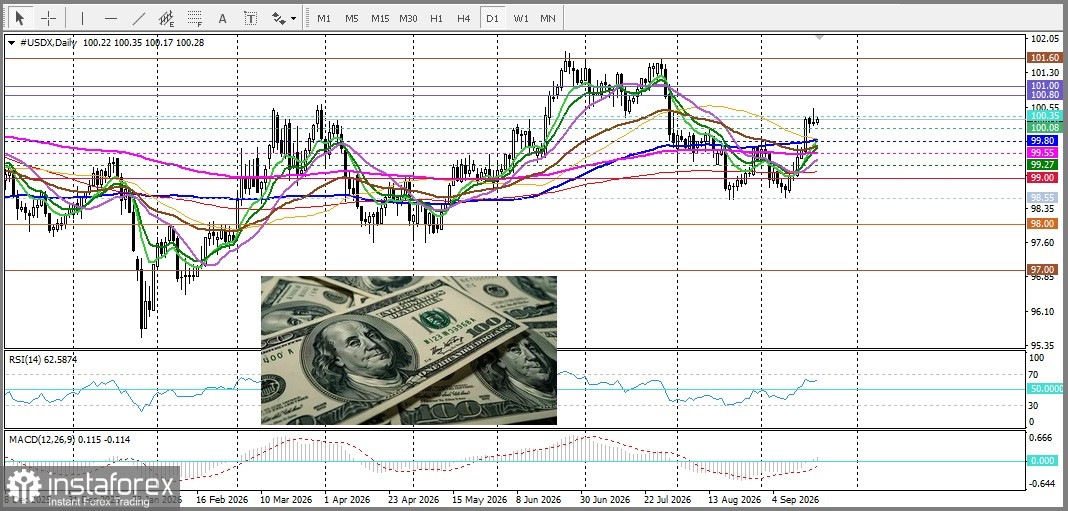
Among the latest developments, it is worth noting a statement by the Iran-backed Yemeni Houthis that they attacked critical facilities in Riyadh, the capital of Saudi Arabia, on Saturday using missiles and drones. Another important factor was Iran's statement outlining seven conditions for resuming negotiations with the United States. This keeps the geopolitical risk premium elevated and, together with the aggressive stance of the U.S. Federal Reserve, supports the dollar as a safe-haven asset and puts pressure on EUR/USD.
It should be recalled that at its September meeting, held last Wednesday, the U.S. central bank raised interest rates for the first time in more than three years. In addition, the so-called "dot plot" showed that committee members expect one more rate hike this year.
On the other hand, the European Central Bank expressed the view that price pressures could persist longer than previously expected. This strengthens expectations of tighter monetary policy in October and provides support for EUR/USD.
Today, Monday, ECB President Christine Lagarde is scheduled to speak, and her remarks could have a significant impact on the euro's performance. Nevertheless, the main focus should remain on geopolitical developments. Together with the important meeting between U.S. President Donald Trump and Chinese President Xi Jinping scheduled for Thursday, these developments could affect investor sentiment toward risk assets. This, in turn, could influence the U.S. dollar and the short-term dynamics of EUR/USD.
From a technical perspective, EUR/USD retains a bearish bias in the near term, remaining below the 100-day simple moving average (SMA). The nearest support is at 1.1450. If this level fails to hold, the pair could accelerate its decline toward the psychological level of 1.1400 and then into the July demand zone.
To ease the current pressure, the bulls first need to break above the psychological level of 1.1500, followed by the 50-day and 100-day SMAs. A break above these significant barriers would be necessary to support a sustained recovery toward 1.1571 — the 200-day EMA — and 1.1625 — the 200-day SMA. However, with the oscillators remaining negative, the bears retain the advantage.


