
Vea también


 04.06.2026 12:35 AM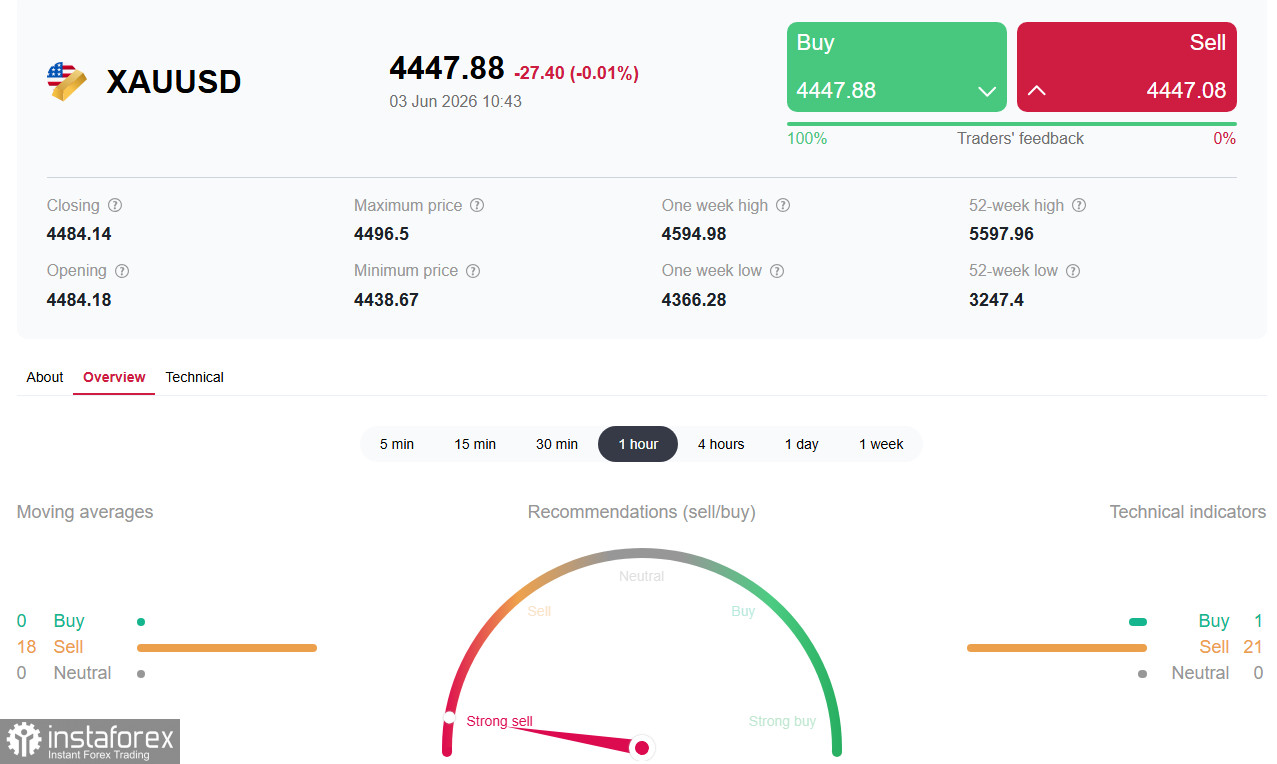
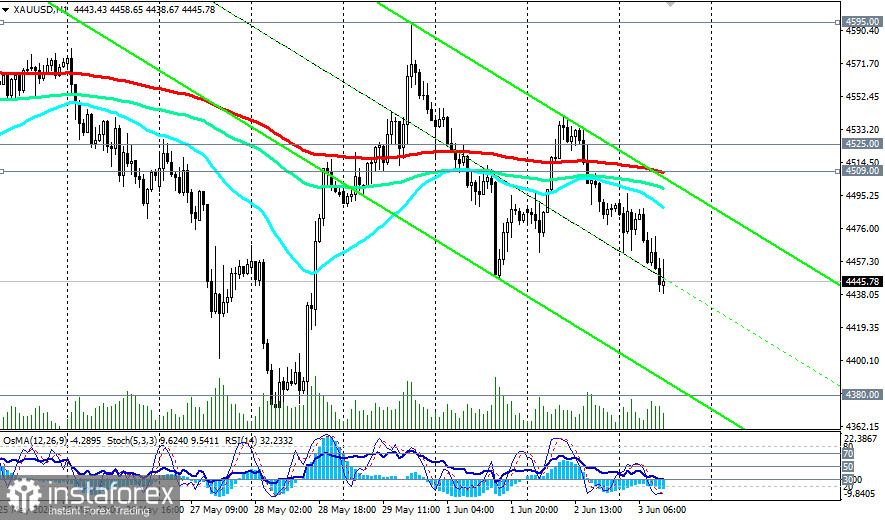
Gold prices enter the middle of the week in a highly vulnerable position. On Wednesday, the precious metal continued its decline, consolidating near the weekly low of 4445.00 at the time of this review. XAU/USD is retreating from the resistance zone of 4590.00–4600.00, where prices have repeatedly failed to break through over the last three weeks during attempts to rise above the "round" mark of 4500.00.
Investors are on edge, assessing the renewed escalation of the conflict in the Strait of Hormuz and growing expectations of a "hawkish" pause from the Federal Reserve, which is exerting significant pressure on the non-yielding asset.
Hopes for a diplomatic breakthrough that temporarily supported markets at the end of May have been completely erased by a new wave of military escalation in the Persian Gulf.
Despite the latest statements from US President Donald Trump claiming that an agreement to extend the ceasefire and open the strait could be reached "as early as next week," Secretary of State Marco Rubio took a hard stance. He stated that Washington would not lift sanctions on Iran in exchange for the full opening of the Strait of Hormuz, and any easing of sanctions would only be possible after significant concessions on the nuclear program.
This dynamic of mutual accusations and strikes (along with the lack of diplomatic breakthroughs) instantly returned the geopolitical premium to prices. However, contrary to the logic of a "safe haven," this strengthened the dollar. Rising oil prices and uncertainty have renewed inflation expectations and hawkish rate prospects for the Fed.
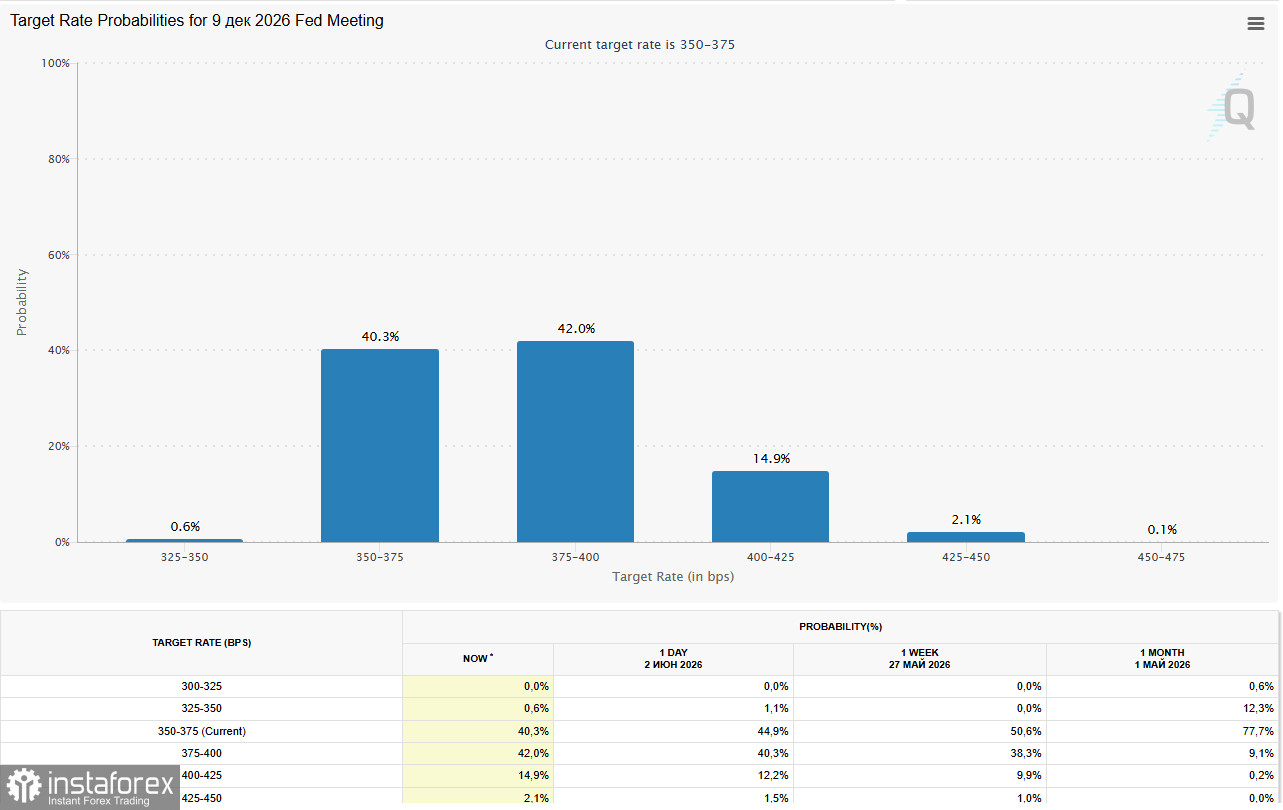
Alongside geopolitics, the main driver of pressure remains the Fed's reevaluation of monetary policy expectations. According to the CME FedWatch tool, markets are pricing in nearly a 60% probability of a 25 bps rate hike by the end of 2026.
From a technical standpoint, the price has confirmed a trend change, forming classic bearish signals on the 4-hour chart for XAU/USD.
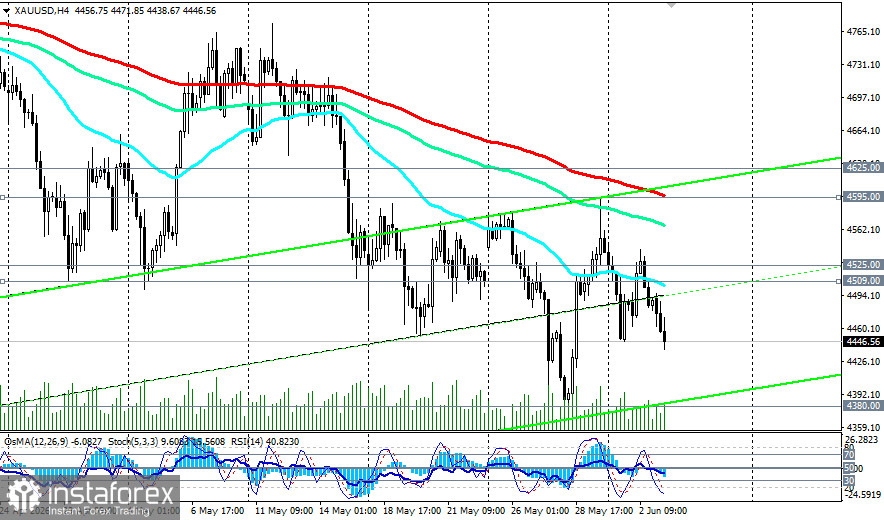
The price remains below the 50-, 144-, and 200-period exponential moving averages, indicating a classic sign of continued short-term bearish control.
On the daily chart, the price stays below the 144-day EMA (4525.00) and the 50-day EMA (4625.00). Only the 200-day EMA (4380.00) is preventing the metal from falling deeper.
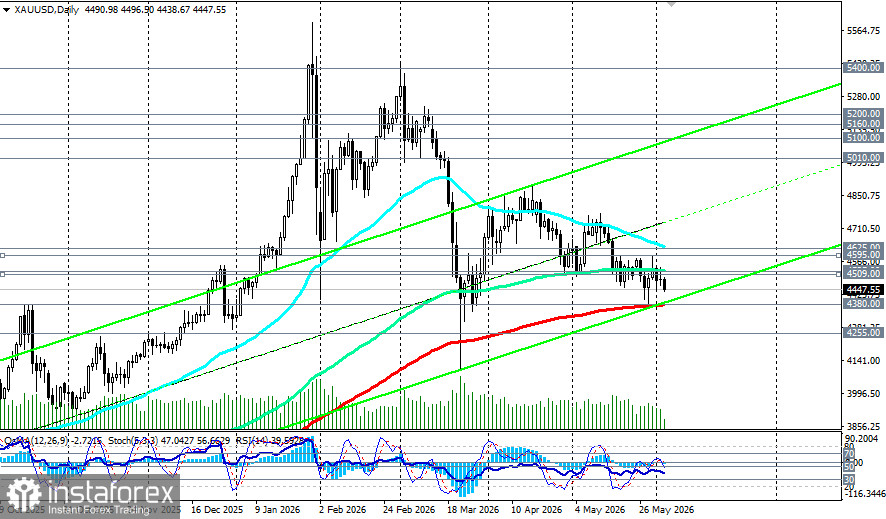
The main scenario anticipates continued downward movement. A confident break and consolidation below the key support level of 4380.00 will open the door to 4300.00 (the area of strong institutional demand), and then down to 4255.00 (the 50-day EMA on the weekly chart and the breakdown zone of the mid-term upward trend).
| Date | Event | Expected Impact |
|---|---|---|
Wednesday (June 3), 12:15 GMT | ADP Employment Change Data (May) | Forecast: 150-170K; strong figures will boost the dollar |
Wednesday (June 3), 14:00 GMT | ISM Services PMI Index (May) | Assessment of the resilience of the services sector |
Wednesday (June 3), 18:00 GMT | Federal Reserve Beige Book Publication | Assessment of the state of the economy |
Friday (June 5), 12:30 GMT | Nonfarm Payrolls (NFP) Report (May) | Key macro-trigger—forecast: 85-95K; weak data will weaken the dollar |
Weekend | Development of US-Iran Negotiations | Main geopolitical trigger—signing of deal or new escalation |
Gold is under significant double pressure. The escalation of the conflict in the Strait of Hormuz and rising oil prices are influencing dollar strength, while the Fed's hawkish stance continues to raise expectations for interest rate hikes.
The current technical picture remains bearish, with the price holding below the 200-period EMA on the 4-hour chart. The market retains its downward structure: each new rise meets selling pressure, and highs are gradually decreasing.
The key zone of 4525.00-4400.00 will be the battleground in the coming days. A technical breakdown below this area will confirm the bearish scenario and open the pathway to 4380.00 and 4300.00. A return above 4525.00 would be the first sign of weakening pressure.
Developments in the Middle East continue to influence risk sentiment and the direction of the USD and gold, while the technical picture favors sellers. Investors should closely monitor Friday's labor market data—it will determine whether the dollar gains enough momentum to break through the 4380.00 level.


