
یہ بھی دیکھیں


 06.08.2026 04:32 AM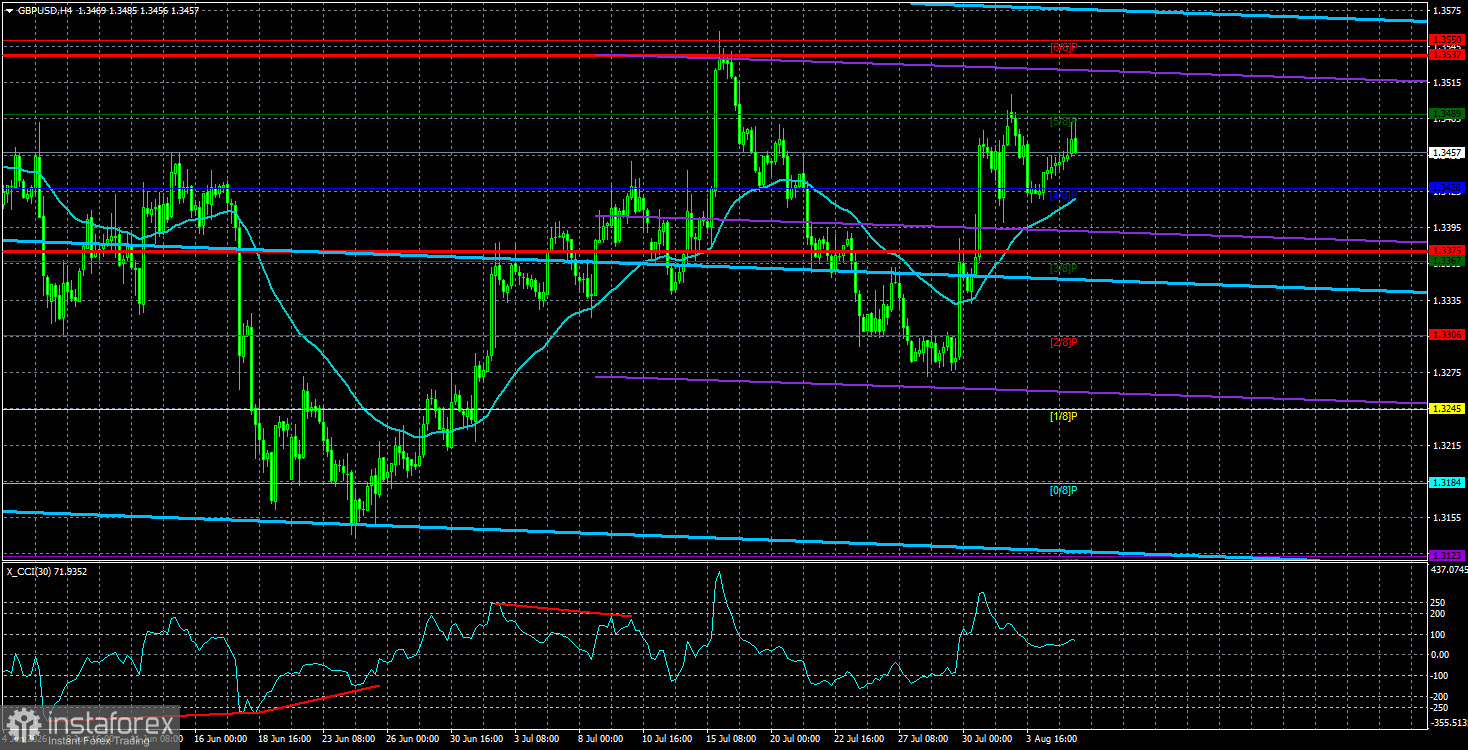
The GBP/USD currency pair also resumed its upward movement on Wednesday, although there were few strong local reasons for it. Again, we want to emphasize that we do not believe the dollar is falling because geopolitical tension has eased or because the Strait of Hormuz may be opened. First, there is no real easing of tensions. Iran and the U.S. can resume military actions at any moment, and there have already been more escalations after ceasefires than a neighbor's cat has eaten cutlets in its life. Second, the Strait of Hormuz has been opened several times before, but it remains Iran's key lever of pressure on the world. Therefore, in the event of a new conflict, the strait will be closed again. Third, the British pound has ample technical grounds for growth. Fourth, the market has already priced in Federal Reserve rate hikes that may never happen. In our view, the dollar is overbought across the market, and global factors point only to its decline.
Overall, we have been expressing such views for quite some time. However, one must understand that "black swans" have not been canceled. Who could have predicted that Donald Trump would start a full-scale war in the Middle East? According to many experts, even Trump did not expect the war to last five months. If the initiator of the war could not predict its timing or clearly state its goals, then no one in the markets could have forecast such developments either. If it had not been for the war in the Middle East, the pound would long ago be trading above 1.4000. Recall that the current year began with the pound rising almost to 1.3900. Only when the Middle East started "to smell of burning" did the pound and the euro fall and the dollar rise. However, our long-term expectations have not changed. Essentially, the conflict in the Middle East and the dollar's strengthening only gave traders a chance to buy at more favorable prices.
It should also be noted that a war between Iran and the U.S. could last for years. We understand this is hard to believe right now, but why is it impossible? The conflict between Moscow and Kyiv is now in its fifth year... Remember that the key nuclear-energy issue remains unresolved, and after five full months of war, the parties are still struggling to resolve the Hormuz situation. In other words, Trump's war greatly worsened the situation in the Middle East and provoked an energy crisis worldwide. Now the question being decided is how at least to open the Strait of Hormuz; nobody is thinking about the nuclear issue yet.
Geopolitics may, at some point, start working against the U.S. dollar. Once the market realizes that the American economy gains nothing positive from the conflict and that Fed tightening remains only a dream, sentiment could shift. If the conflict ends, Trump will again pressure the Fed to cut the key rate.
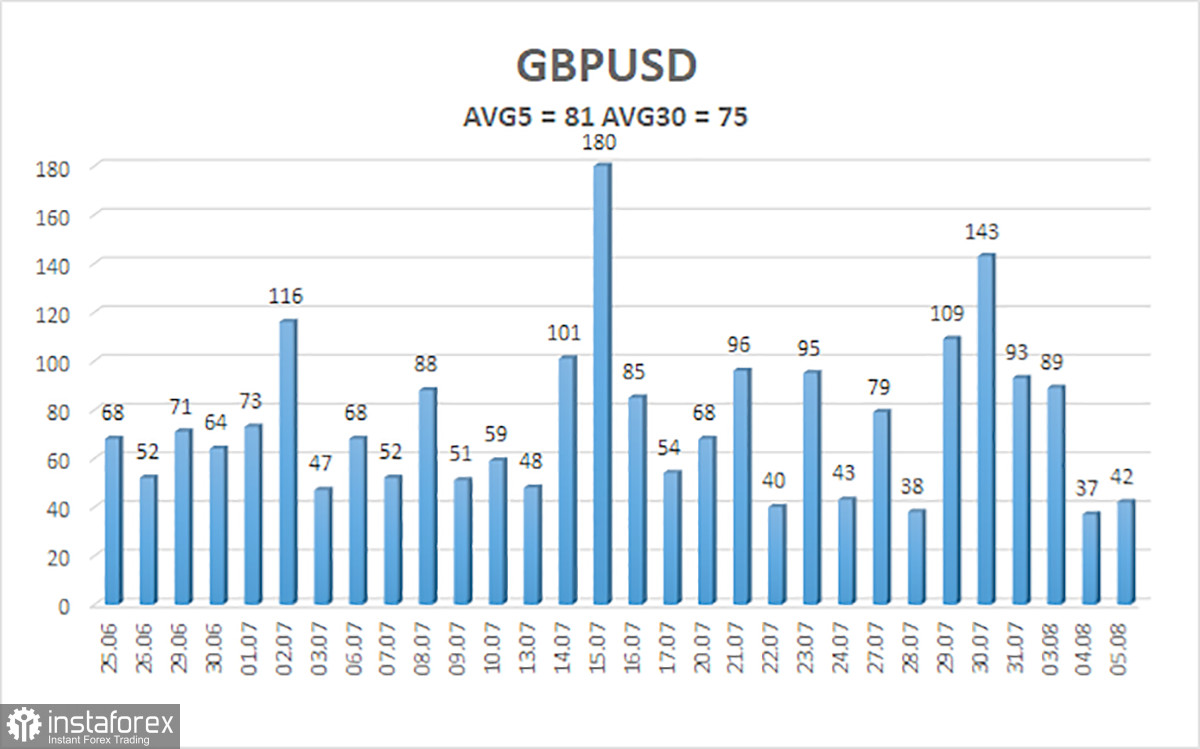
The average volatility of the GBP/USD pair over the last 5 trading days is 81 pips. For the pound/dollar pair, this value is "average." On Thursday, August 6, we therefore expect movement within a range bounded by 1.3375 and 1.3537. The upper linear regression channel is directed downward, indicating a continuation of the downtrend. The CCI indicator entered the overbought area twice, which may provoke a new downward correction.
S1 – 1.3428
S2 – 1.3367
S3 – 1.3306
R1 – 1.3489
R2 – 1.3550
R3 – 1.3611
The GBP/USD pair retains an upward tendency. Trump's policies will continue to weigh on the U.S. economy, so we do not expect long-term strength in the U.S. dollar. The year 2026 has so far been very positive for the dollar due to geopolitics, but every fairy tale comes to an end. On the weekly timeframe, the pair remains in a flat between 1.3150 and 1.3780 within a four-year uptrend, which supports expectations of continued pound appreciation in the medium term. Long positions with targets of 1.3537 and 1.3550 can be considered when the price is above the moving average. When the price is below the moving average, short positions targeting 1.3367 and 1.3306 can be considered.


