
یہ بھی دیکھیں


 30.04.2026 09:00 AM
Yesterday, Bitcoin dropped to around $75,000, while Ethereum reached a level of $2,218.

Pressure on the digital asset market has sharply increased following yesterday's Federal Reserve meeting. Even though the Federal Open Market Committee voted to keep the key interest rate unchanged at 3.75%, indications of a more active fight against inflation and geopolitical concerns related to the situation in the Middle East have intensified pressure on the value of Bitcoin and Ethereum.
Despite the interest rate remaining the same, the meeting's minutes revealed a more hawkish tone among some committee members. This indicates heightened concern over inflation risks and a willingness to take more decisive measures to address them. With central banks in other countries also maintaining fairly restrictive monetary policies, signals from the Fed create a broader backdrop of uncertainty for risk assets, which typically include cryptocurrencies.
The geopolitical tension in the Middle East adds fuel to the fire. Oil prices have already surged above $112 per barrel, and any escalation of conflict that could affect global energy prices and disrupt supply chains will inevitably increase overall nervousness in financial markets. Digital assets, being sensitive to global economic and political events, will respond to such news with sell-offs. The dynamics of Bitcoin and Ethereum yesterday vividly demonstrated this correlation, signaling that the cryptocurrency market is becoming increasingly integrated into the overall system of global risks.
Regarding the intraday strategy in the cryptocurrency market, I will continue to rely on any significant pullbacks in Bitcoin and Ethereum, anticipating the continuation of the bullish market in the long term, which has not disappeared.
In terms of short-term trading, the strategy and conditions are outlined below.
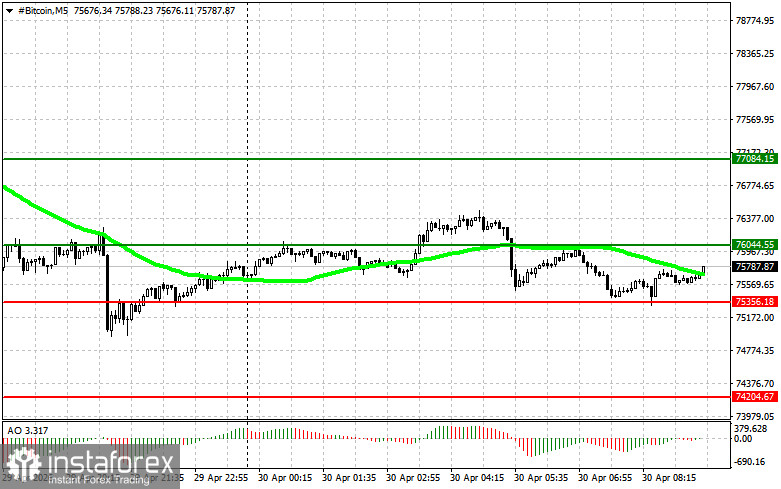
Scenario No. 1: I plan to buy Bitcoin today at an entry point around $76,000, with a target of $77,000. At $77,000, I plan to exit the buys and sell immediately on the bounce. Before buying on a breakout, ensure the 50-day moving average is below the current price and the Awesome indicator is above zero.
Scenario No. 2: I can buy Bitcoin at the lower boundary of $73,500 if there is no market reaction to a breakout back to $76,000 and $77,000.
Scenario No. 1: I plan to sell Bitcoin today upon reaching an entry point around $75,300, with a target drop to $74,200. At $74,200, I plan to exit the sales and immediately buy on the bounce. Before selling on a breakout, ensure that the 50-day moving average is above the current price and that the Awesome indicator is in the zone below zero.
Scenario No. 2: I can sell Bitcoin at the upper boundary of $76,000 if there is no market reaction to a breakout back to $75,300 and $74,200.
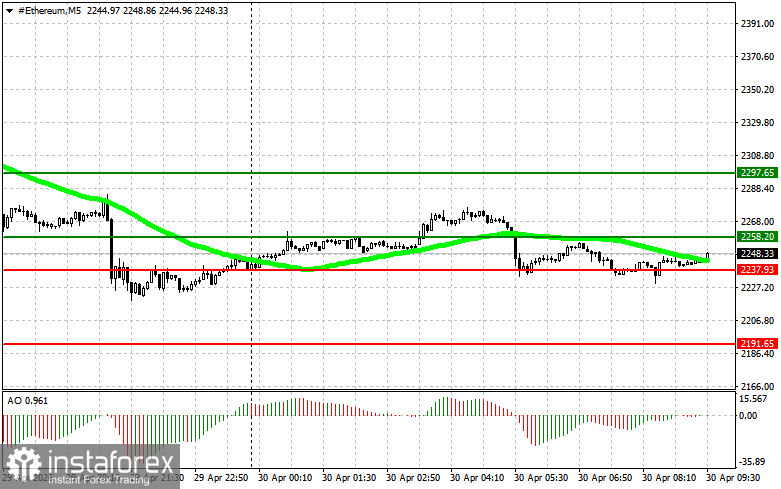
Scenario No. 1: I plan to buy Ethereum today upon reaching an entry point around $2,258, with a target price of $2,297. At $2,297, I plan to exit the buys and sell immediately on the bounce. Before buying on a breakout, ensure the 50-day moving average is below the current price and the Awesome indicator is above zero.
Scenario No. 2: I can buy Ethereum at the lower boundary of $2,237 if there is no market reaction to a breakout back to $2,258 and $2,297.
Scenario No. 1: I plan to sell Ethereum today upon reaching an entry point around $2,237, with a target drop to $2,191. At $2,191, I plan to exit the sales and immediately buy on the bounce. Before selling on a breakout, ensure that the 50-day moving average is above the current price and that the Awesome indicator is in the zone below zero.
Scenario No. 2: I can sell Ethereum at the upper boundary of $2,258 if there is no market reaction to a breakout back to $2,237 and $2,191.


