
یہ بھی دیکھیں


 17.12.2025 01:23 PM
The wave count on the 4-hour chart for EUR/USD has changed, but overall it still remains quite clear. There is no talk of canceling the upward segment of the trend that began in January 2025; however, the wave structure since July 1 has taken on a complex and extended form. In my view, the instrument has completed the construction of corrective wave 4, which has taken on a very non-standard shape. Within this wave, we observed exclusively corrective structures, so there is no doubt about the corrective nature of the decline.
In my opinion, the construction of the upward trend segment is not complete, and its targets extend as far as the 25th figure. The series of waves a–b–c–d–e looks complete; therefore, over the coming weeks I expect the formation of a new bullish wave sequence. We have seen the presumed waves 1 and 2, and the instrument is now in the process of forming wave 3, or wave c. I expected that within this wave the instrument would rise to the 1.1717 level, which corresponds to the 38.2% Fibonacci retracement. However, this wave is taking on a more extended form, which is very positive, as it may turn out to be impulsive—along with the entire bullish wave sequence.
The EUR/USD exchange rate continued to rise throughout Tuesday, and again, there is no need to look for an explanation. While during the European session the market had fairly specific reasons to sell the euro, during the U.S. session it had reasons only to sell the dollar. Economic data from the eurozone were certainly interesting, but in the United States, labor market and unemployment data were released that the market had been eager to see for more than two months. Moreover, let me remind you that the Federal Reserve once again made its rate decision "blindly" last week. It is now becoming clear that cutting interest rates for the third time was an absolutely correct decision. The U.S. labor market continues to "cool," and that is putting it very mildly. We will discuss the impact of economic data on the outlook for Fed monetary policy in a separate review; here, I will keep it brief.
The EUR/USD pair continues to build a bullish wave sequence. Yesterday's news background could have disrupted the wave count, but this did not happen, as the most important reports of the day turned out to be extremely negative for the U.S. dollar. Overall, I can focus readers' attention on just one report—the unemployment rate. This indicator rose to 4.6% in November, something few expected. What difference does it make how many new jobs were created if the unemployment rate jumped by 0.2% at once? Whether 500,000 or any other number is irrelevant. That said, the payrolls reports for October and November also contributed to the dollar's decline. The October report was so poor that the November figures no longer mattered much to market participants.
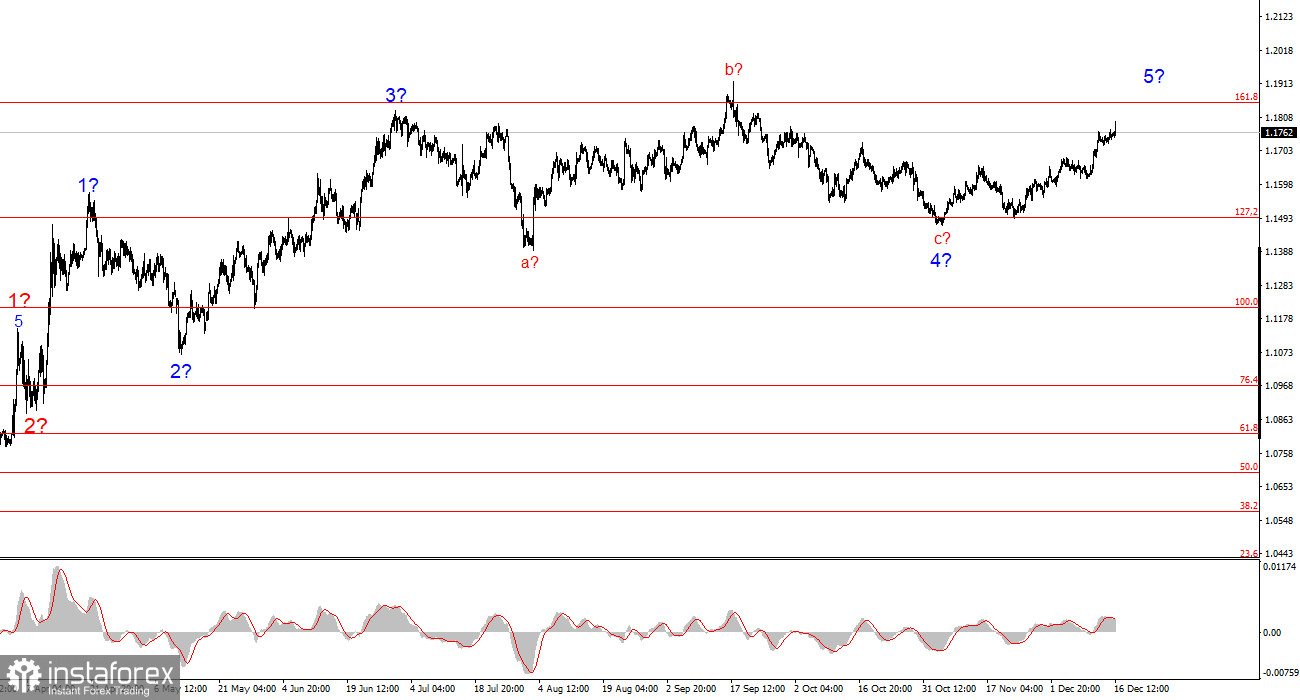
Based on this EUR/USD analysis, I conclude that the instrument continues to build an upward trend segment. Donald Trump's policies and the Federal Reserve's monetary policy remain significant long-term factors weighing on the U.S. dollar. The targets of the current trend segment may extend as far as the 25th figure. The current bullish wave sequence is beginning to gain traction, and one would like to believe that we are now witnessing the formation of an impulsive wave structure as part of the global wave 5. In this case, growth toward the 25th figure should be expected, as I have mentioned before.
On a smaller scale, the entire upward trend segment is visible. The wave count is not entirely standard, as corrective waves differ in size. For example, the larger wave 2 is smaller than the internal wave 2 within wave 3. However, this does happen. Let me remind you that it is best to identify clear and understandable structures on charts, rather than rigidly attaching to every single wave. At present, the bullish structure raises no doubts.
Key Principles of My Analysis


