
یہ بھی دیکھیں


 17.10.2025 08:18 AM
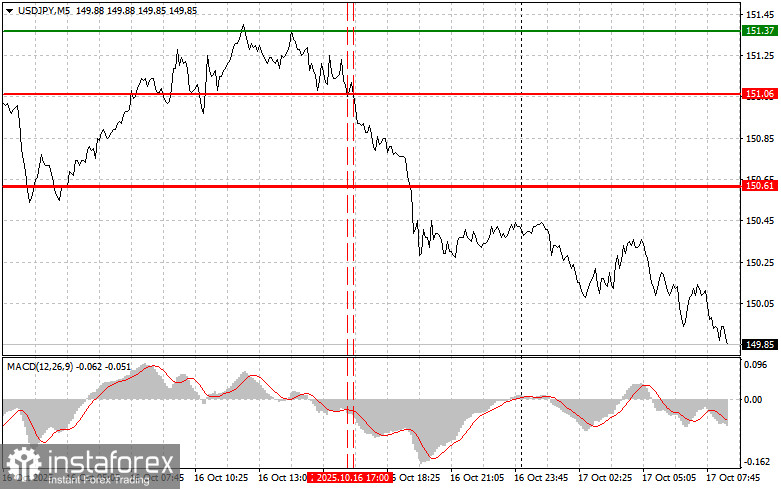
The test of the 151.06 price level occurred when the MACD indicator had already moved significantly below the zero line, limiting the pair's downside potential. A second test of this price coincided with the MACD being in oversold territory, which triggered Buy Scenario No. 2; however, the pair ultimately failed to rise from that level.
The Japanese yen continues to show stable strength. However, the decline in the USD/JPY pair is due more to weakness in the U.S. dollar than to inherent strength in the yen. The yen is traditionally viewed as a safe-haven currency, and during periods of global economic instability—such as that caused by the ongoing U.S.–China trade tensions—demand for the yen tends to rise. That said, in the current situation, expectations of a dovish shift in Federal Reserve policy hold a more powerful influence over USD/JPY dynamics.
Fundamentally, Japan's economic data offers mixed signals. While exports remain relatively resilient, domestic demand remains weak. Under such conditions, the Bank of Japan is unlikely to adopt a hawkish stance or tighten monetary policy in the near future.
As for today's intraday strategy, I will mainly rely on executing Scenarios No. 1 and No. 2.
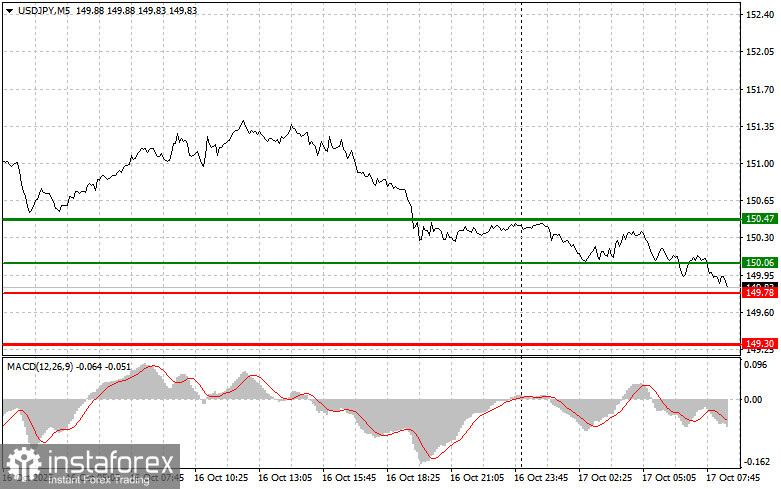
Scenario No. 1: I plan to buy USD/JPY today if the price reaches the entry point near 150.06, targeting a rise to 150.47. Around the 150.47 level, I plan to exit the long position and open a short trade in the opposite direction, targeting a move of 30–35 pips down from that level. Buying the pair is most effective after corrections or significant pullbacks. Note: Before entering a buy trade, make sure the MACD indicator is above the zero line and just beginning to turn upward.
Scenario No. 2: I also plan to buy the pair if there are two consecutive tests of the 149.78 level while the MACD indicator is in oversold territory. This would limit bearish potential and hint at a potential reversal upward. In that case, growth toward the 150.06 and 150.47 levels can be expected.
Scenario No. 1: I plan to sell USD/JPY only after a confirmed breakdown below the 149.78 level, which could lead to a swift decline. The primary target for sellers in this case is the 149.30 level. I plan to exit short positions there and immediately open long positions on a rebound, targeting a 20–25 pip recovery. It is preferable to sell from as high a level as possible. Note: Before entering a sell trade, ensure the MACD indicator is below the zero line and just starting to decline.
Scenario No. 2: I will also consider a sell position if the 150.06 level is tested twice consecutively while the MACD indicator is in overbought territory. This would limit the pair's upward potential and likely cause a reversal downward. A drop toward 149.78 and then 149.30 is expected in that case.
Beginner traders in the Forex market must be especially cautious when entering trades. It is best to stay out of the market during the release of important economic reports to avoid getting caught in sharp and unpredictable price swings.
If you choose to trade around news announcements, always place stop-loss orders to manage risk. Without a stop-loss, your entire account could be wiped out quickly—especially if you ignore money management principles and trade with oversized positions.
And remember: for successful trading, a clear plan—such as the one presented above—is essential. Spontaneous decision-making based on market noise is an inherently losing strategy for intraday traders.


