
আরও দেখুন


 29.12.2025 05:48 PM
The wave count on the 4-hour chart for EUR/USD looks quite clear, although fairly complex. There is no talk of canceling the bullish trend segment that began in January 2025, but the wave structure starting from July 1 has taken on a complex and extended form. In my view, the pair has completed the formation of corrective wave 4, which took a very unconventional shape. Within this wave, we observed exclusively corrective structures, leaving no doubt about the corrective nature of this wave.
In my opinion, the formation of the bullish trend segment has not been completed, and its targets extend as far as the 1.25 level. The series of waves a–b–c–d–e appears complete; therefore, I expect the formation of a new bullish wave sequence in the coming weeks. We have seen the presumed waves 1 and 2, and the pair is now in the process of forming wave 3, or C. This wave is becoming quite extended, which is very positive, as it may turn out to be impulsive. Along with it, the entire bullish wave sequence may also become impulsive.
The EUR/USD pair showed no change throughout Monday. And what changes could be expected on the first day of the New Year's week? The amplitude of price movements was around 20 points, and market activity was truly holiday-like. Under such conditions, even a strong news background is unable to move prices, because what matters is not the news itself, but how market participants react to it.
However, there will be virtually no news this week either. The most important event can be considered the release of the minutes from the December Federal Reserve meeting—and that is ironic. This event is the most important simply because it is the only one. In general, the market almost always ignores FOMC minutes for several reasons. First, they are released three weeks after the meeting itself. Second, all the necessary information is communicated by Jerome Powell immediately after the meeting. Third, all essential details are contained in the Fed's official statement. Fourth, over the three weeks following the meeting, nearly all FOMC members have spoken publicly and expressed their views. Fifth, during these three weeks, a large number of important U.S. economic reports have been released, so by now the market has little interest in the sentiment of FOMC members regarding monetary policy back in early December.
All indications suggest that this document will once again fail to attract any interest from the market. Let me remind you that for the U.S. dollar, inflation, unemployment, and labor market data are currently far more important than formal FOMC minutes that are three weeks old. Based on all of the above, I expect weak price movement amplitude this week and a complete lack of willingness from the market to trade.
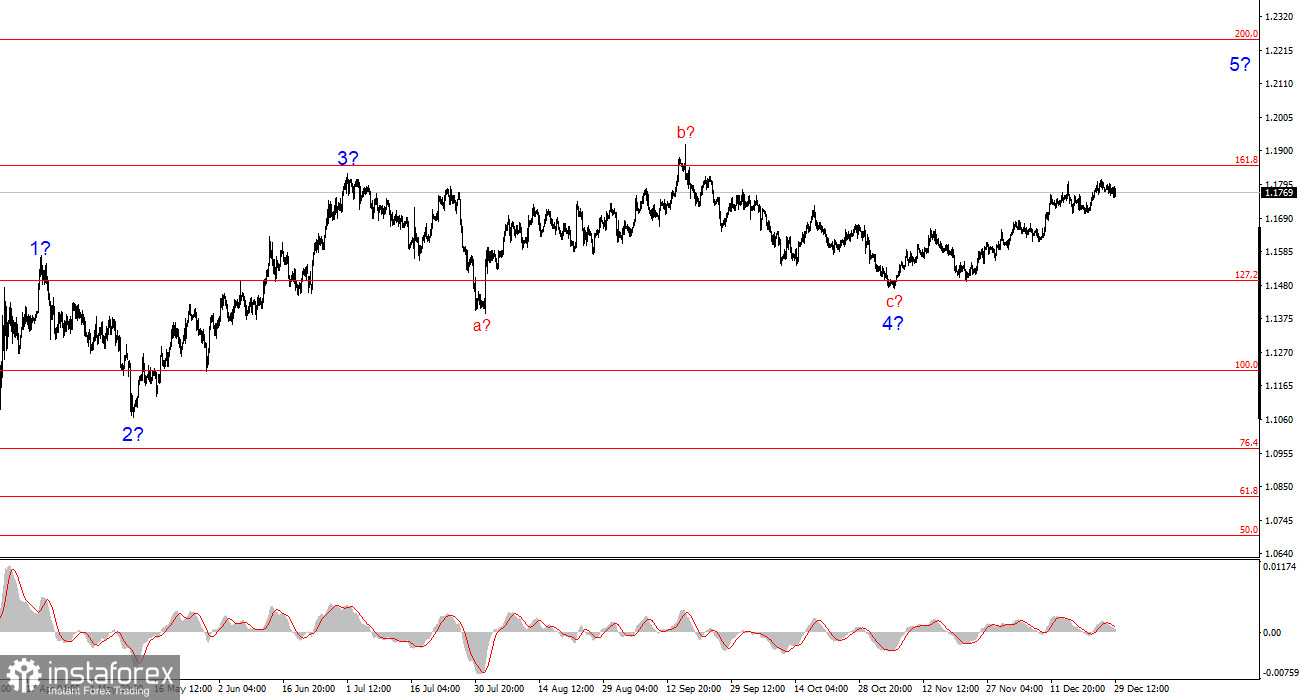
Based on the conducted EUR/USD analysis, I conclude that the instrument continues to form a bullish trend segment. Donald Trump's policies and the Federal Reserve's monetary policy remain significant long-term factors weighing on the U.S. dollar. The targets of the current trend segment may extend as far as the 1.25 level. The current bullish wave sequence is beginning to gain momentum, and one can hope that we are now observing the formation of an impulsive wave sequence that is part of the global wave 5. In this case, growth should be expected with targets around 1.1825 and 1.1926, corresponding to the 200.0% and 261.8% Fibonacci levels.
On a smaller scale, the entire bullish trend segment is visible. The wave count is not entirely standard, as corrective waves vary in size. For example, the higher-degree wave 2 is smaller than the internal wave 2 within wave 3. However, such cases do occur. I would like to remind you that it is best to identify clear and understandable structures on charts rather than rigidly adhering to every individual wave. At present, the bullish structure raises no doubts.


