
Lihat juga


 14.10.2026 07:15 PM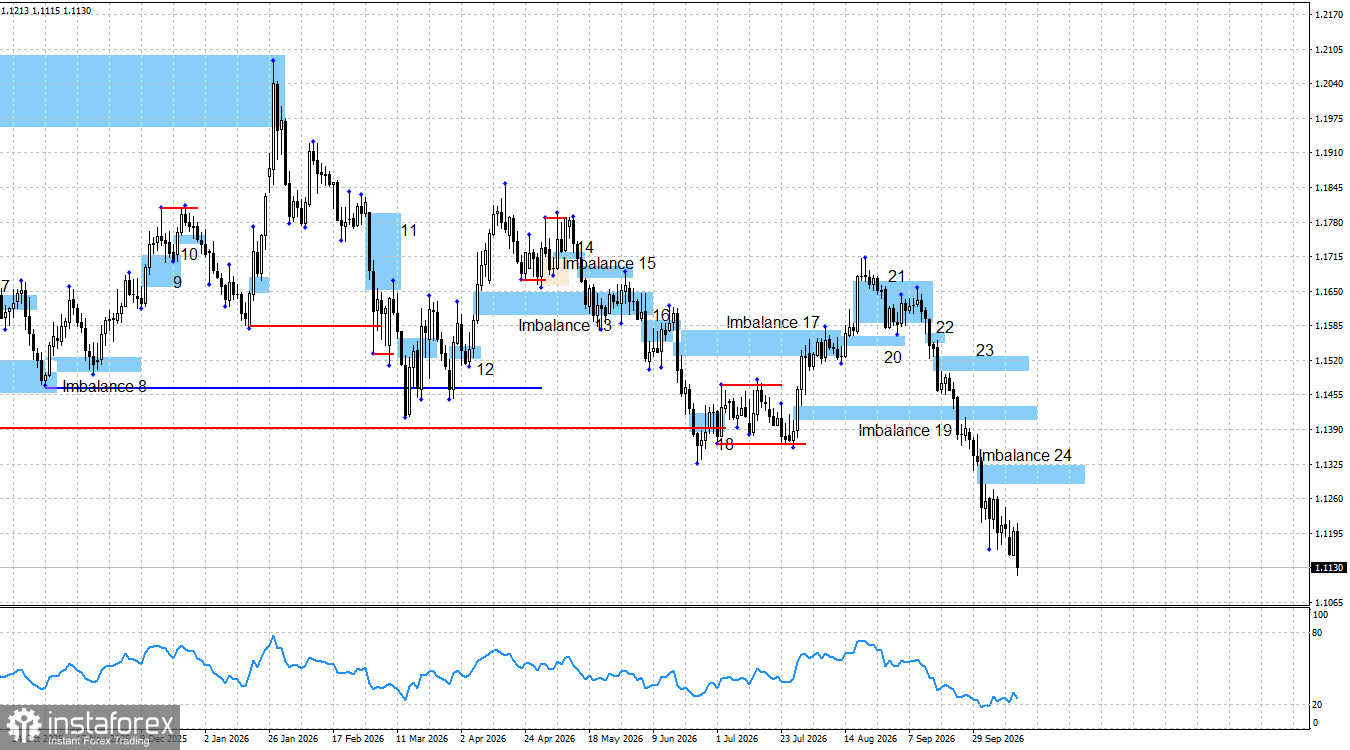
The EUR/USD pair has declined for 25 consecutive days, with only brief pauses. During this period, the euro has lost 530 points. The decline began more than a month ago as the market prepared for an FOMC rate hike. Since then, market participants have continued buying the U.S. dollar, using various developments as justification for further purchases. In trading terminology, such movements are associated with order flow. Large market participants typically accumulate orders within a price range over a certain period before these orders begin to be executed. At that point, the prevailing news flow becomes less relevant, as the orders have already been placed and are being executed.
For example, last week, traders had virtually no reason to sell EUR/USD, apart from France's budget crisis. Nevertheless, the euro continued to decline. At the beginning of the new week, selling pressure resumed despite the absence of significant market-moving news. Yesterday, however, Beth Hammack, President of the Federal Reserve Bank of Cleveland and an FOMC participant, stated that interest rates should be raised at a faster pace without pauses. This provided traders with an additional reason to buy the U.S. dollar. Today, the latest U.S. inflation report was released. Inflation exceeded forecasts, prompting further selling of the euro. The bulls failed to take advantage of available opportunities, while the bears continued to dominate the market.
The euro's decline remains uninterrupted. The ECB's tighter monetary policy, favorable economic data from the European Union, disappointing U.S. labor market data, and bullish technical patterns have all failed to reverse the downward trend. With Imbalance 19 invalidated, the euro could now fall below the psychological level of $1.10. The former bullish Imbalance 19 has turned into a bearish inverted imbalance, generating a sell signal. The bulls failed to capitalize on two bullish swings and disappointing U.S. labor market data. The bears resumed their advance without even waiting for Imbalance 24 to be mitigated.
In September, the FOMC not only raised interest rates but also signaled its willingness to continue tightening monetary policy. This was enough to sustain the bears' large-scale advance. Even after the Fed tightened monetary policy in September, with further tightening possible in October or December, it would be incorrect to conclude that the euro received no positive news during this period.
Overall, the news background, in my view, continues to favor the bulls. Although the Fed has adopted a more hawkish monetary policy stance, this is not the only factor determining exchange rates. It is worth remembering that U.S. Treasury yields are reaching record highs, placing considerable pressure on the federal budget; the U.S. economy has slowed in recent quarters; U.S. labor market data have more often disappointed than exceeded expectations; Donald Trump resumed a series of trade and non-trade disputes with numerous countries in 2026; and the U.S. stock market continues to raise serious concerns because of uncontrolled, debt-financed investment in technology companies involved in AI development. The European Union also faces problems, but that is precisely the point: problems exist everywhere, yet only the euro is declining.
The current technical picture indicates that bearish momentum remains firmly in place, with few signs of reversal. The only relevant pattern at present is Imbalance 24, which is unlikely to be mitigated in the near term, as the bears do not even appear to need a pause. The bulls' only remaining opportunity may be to sweep the liquidity below the 1.1066 low. However, the probability of this scenario playing out is extremely low.
Wednesday's economic news was dominated by the U.S. inflation report. It gave the bears a reason to resume their attacks, and they took advantage of it. Inflation came in above forecasts, increasing the likelihood that the FOMC will tighten monetary policy by a cumulative amount exceeding 0.25%.
The bulls still have plenty of reasons to launch an advance in 2026. Structurally and globally, Trump's policies—which led to a substantial decline in the U.S. dollar last year—have not changed. At present, there are no significant factors supporting the U.S. currency, despite the FOMC's hawkish stance. Geopolitical developments, which supported demand for the U.S. dollar during much of the first half of 2026, are no longer doing so.
Economic Calendar for the United States and the European Union:
On October 15, the economic calendar contains four entries, none of which are considered important. The impact of the economic news on market sentiment on Thursday may be limited or negligible.
In my view, the pair remains within a broader bullish trend that has been undergoing a corrective pause for an entire year. The news background shifted sharply in favor of the bears seven months ago, but the four-year trend itself cannot yet be considered invalidated or complete. The bulls may resume their advance before the end of the year, but their only realistic opportunity at present is the 1.1066 low established in June last year. The bears have received a new sell signal from Imbalance 19. At this stage, existing sell positions should be kept open. The bears are so confident in their position that they have not even needed price to rebalance within Imbalance 24. The bulls have little left to do but hope for a miracle.


