
Vea también


 16.06.2026 12:51 AM
At the beginning of the new week, the British pound has also shown signs of recovery, but it is unclear how long this will last. I mentioned that the euro and pound exhibit a high level of correlation; therefore, despite some differences in wave structure, they are likely to move in similar directions in the near future. Consequently, the European currency has formed a full five-wave downward structure, while the British pound may limit itself to a three-wave structure. If this assumption is correct and geopolitics does not sharply reverse in an undesirable direction this week, then the GBP/USD instrument has begun to form an upward structure that could turn into an impulsive one. If it becomes impulsive, the pound could rise well above the 37 figure. What events this week could promote the growth of the British currency?
Naturally, geopolitics is one significant factor. The closer we get to Friday, the higher the chances of signing the agreement, opening the Strait of Hormuz, and continuing negotiations on Iran's nuclear energy. I don't know whether the final agreement will be signed, but for a few weeks, the market has had a reprieve. There is no longer a need to flee from risks into the safe dollar every day.
The second important event is the UK's May inflation report. According to forecasts, the consumer price index may accelerate to 3% year-on-year, but this is unlikely to be enough for the Bank of England to change its stance to a more hawkish one. Therefore, we should not expect monetary policy tightening in the UK in the near future. In this case, the pound lacks strong support, but geopolitics can push it higher without assistance from the BoE.
The third important event is the BoE meeting itself. Here, support for the pound may come solely from the MPC's voting on the rate. The market expects that two members of the BoE will vote for a rate hike, but a larger number could provide additional support for the pound, reflecting a more hawkish MPC stance. This week will also see reports on unemployment, wages, and retail sales, but I believe they will be overshadowed by more significant events. Consequently, the British pound currently has a good chance of following the euro, but it is crucial that geopolitics does not deteriorate by the end of the week, as has often happened in recent months.
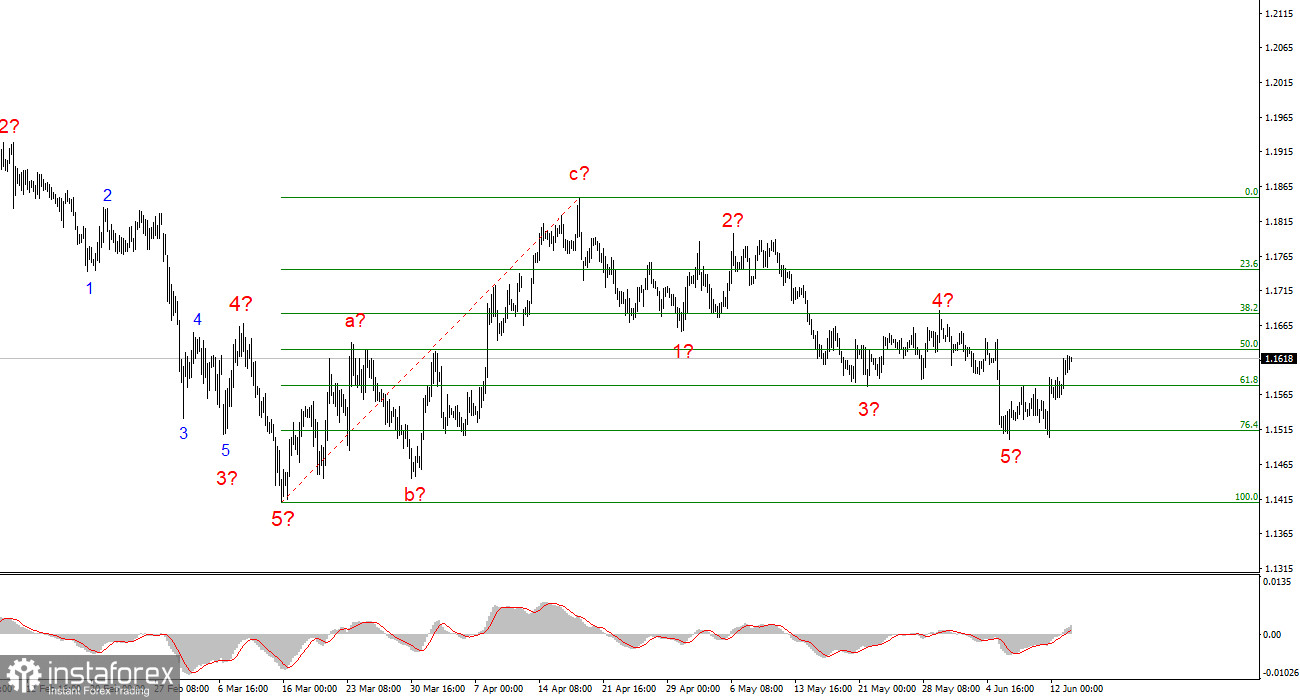
Based on the conducted analysis of EUR/USD, I conclude that the instrument remains within an upward section of the trend, while in the shorter term, it is within a downward section of the trend that may have already completed. In my view, this is a good time to attempt to establish long positions. The unsuccessful attempt to break the 1.1513 mark, corresponding to 76.4% on the Fibonacci scale, combined with the completed appearance of the downward section of the trend, allows us to suggest a transition of the instrument to an upward wave formation with targets around the 17 figure and higher.
The wave structure of the GBP/USD instrument has become clearer. The instrument has currently constructed three waves down, while the EUR/USD has constructed five. Consequently, the pound may limit itself to constructing a corrective structure, and both currency pairs may begin forming upward sections of the trend. At present, this is merely a hypothesis, but it is a plausible one. If it is correct, the instrument will begin to rise with targets around the 35 figure and above. Market participants currently have a good opportunity to buy.


