
Lihat juga


 19.03.2026 07:39 PM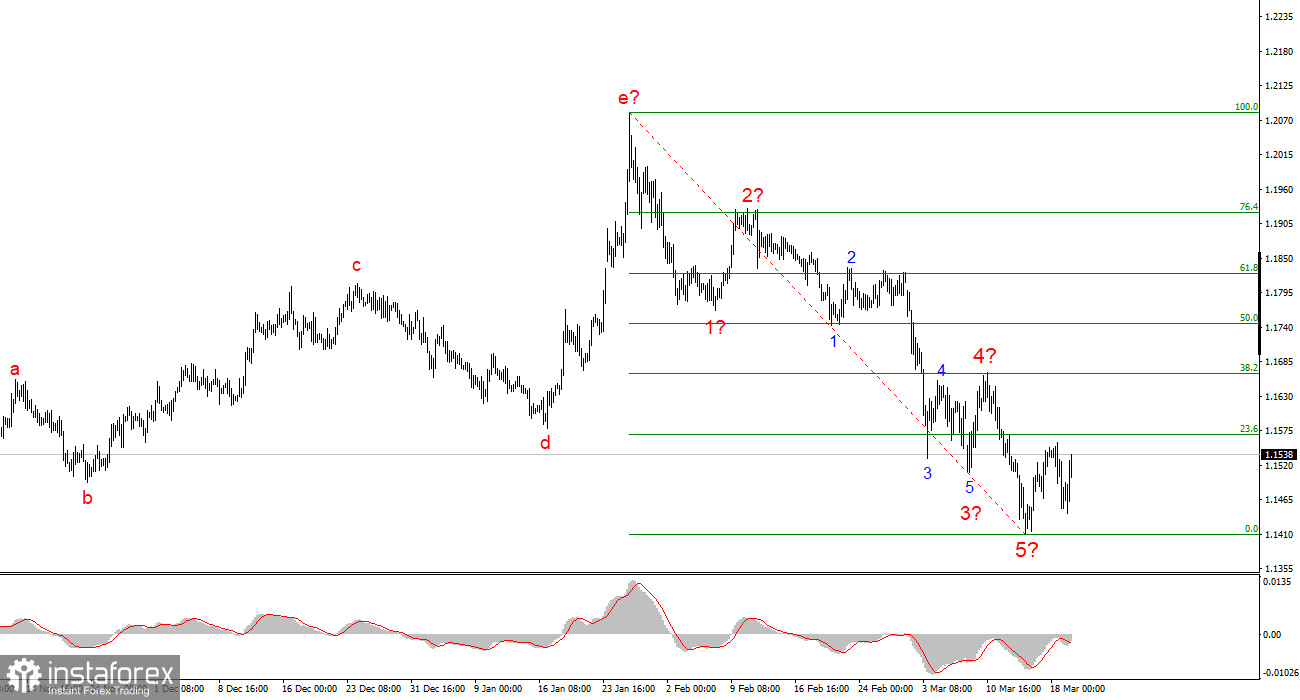
The wave pattern on the 4-hour chart for EUR/USD has changed. There is still no indication that the upward trend, which began in January of last year, has been canceled, but the wave structure now looks very unclear. In such situations, I always recommend switching to a lower timeframe and analyzing the simplest and smallest wave structures in order to make a short-term forecast, which is sufficient for opening trades.
In the chart above, I can identify a classic five-wave impulse structure with an extended third wave. If this is correct, then the formation of this structure has been completed, and we should expect the development of a corrective phase consisting of at least three waves. Therefore, in the near term, an increase in quotes can be expected, but within a correction relative to the most recent trend segment. For now, the latest wave formations do not fit well into the higher-level structure, but the situation should become clearer over time. In the near future, the euro may recover toward the levels of 1.1568 and 1.1666.
The EUR/USD pair rose by 75 basis points on Thursday after a similar decline on Wednesday evening. Recall that the results of the Federal Reserve meeting were released on Wednesday evening, while the ECB and Bank of England decisions were announced on Thursday. As expected, all three central banks adopted a hawkish stance based on concerns about rising inflation. At the same time, none of them showed concern about slowing economic growth, weakening labor markets, or similar risks. Therefore, it can be concluded that inflation is the top priority for regulators.
What conclusions can be drawn from this? Central banks will focus on stabilizing inflation. However, inflation currently differs across the Eurozone, the United States, and the United Kingdom, and it may accelerate at different rates. Therefore, the actions of regulators may diverge in 2026. The Bank of England may face the greatest challenge, as it will need to deal with inflation significantly above 3%. Although consumer price growth has been reduced with difficulty, the conflict in the Middle East could push it back up toward 4%.
In Europe and the United States, the situation is somewhat easier, so the ECB and the Federal Reserve may be able to keep interest rates unchanged unless inflation rises significantly above 3%. All three central banks expect inflation to increase only in 2026, but in reality, no one knows how events in the Middle East will develop. Therefore, the following conclusion can be drawn: the Bank of England may raise interest rates this year, while the ECB and the Fed are more likely to keep rates unchanged. If this scenario plays out, the British pound gains an advantage over the US dollar, which is particularly important under current conditions.
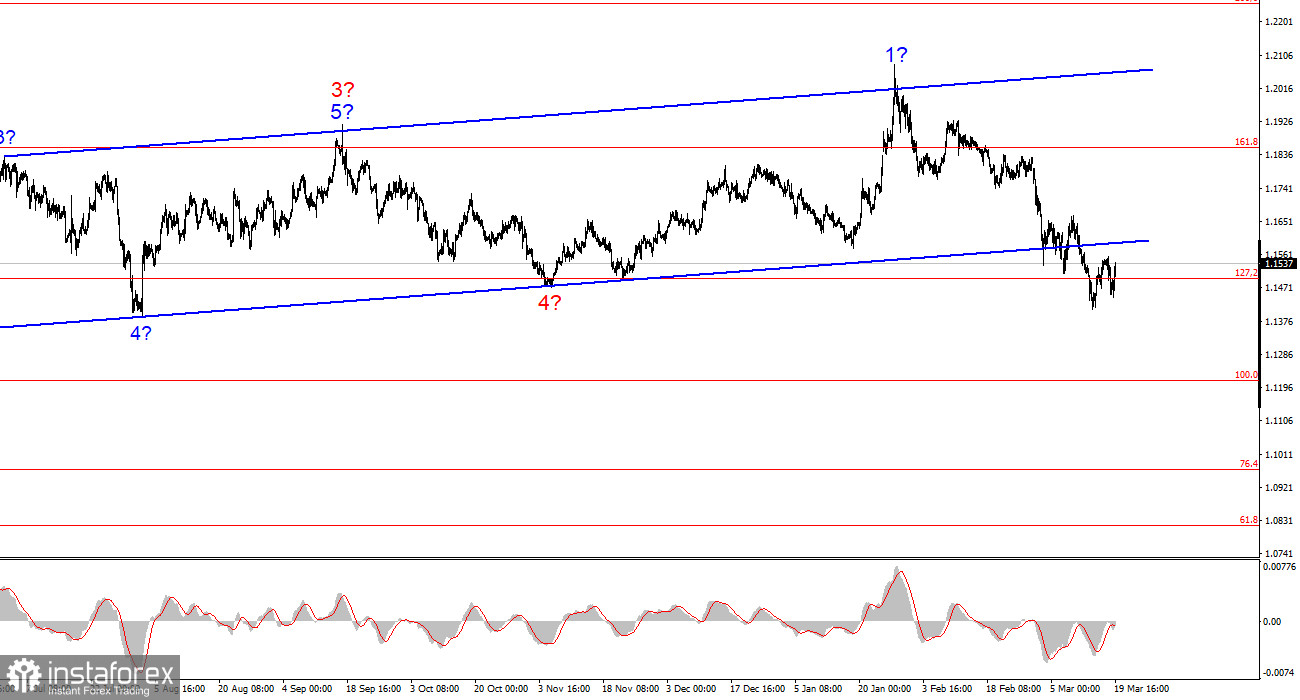
Based on the EUR/USD analysis, I conclude that the pair remains within an upward trend (see lower chart), but has started forming a downward phase in the short term. Since the five-wave impulse structure has been completed, over the next one to two weeks a rise in prices can be expected toward the levels of 1.1568 and 1.1666, corresponding to the 23.6% and 38.2% Fibonacci levels. Further movement will depend entirely on developments in the Middle East.
On the lower timeframe, the entire upward trend is visible. The wave structure is not entirely standard, as corrective waves differ in size. For example, the higher-level wave 2 is smaller than the internal wave 2 within wave 3. This can happen. It is better to focus on clear structures rather than trying to strictly label every wave. The trend may reverse in the near future.
Key principles of my analysis:


