
Lihat juga


 13.03.2026 08:16 PM
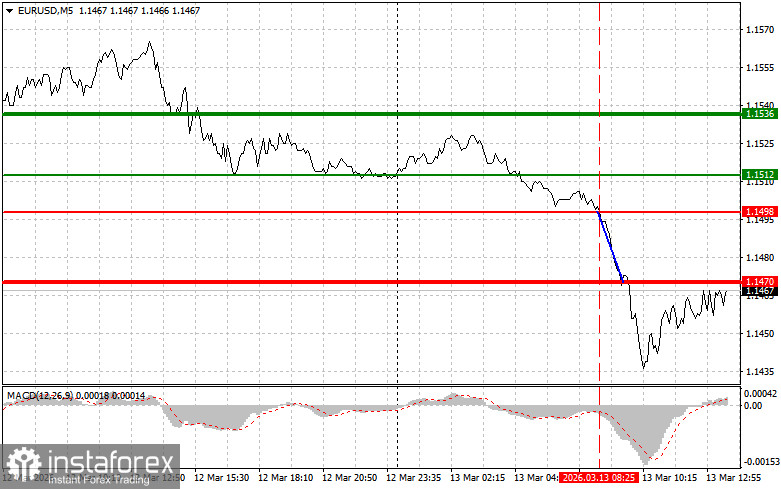
The test of the 1.1498 price occurred when the MACD indicator had just begun moving downward from the zero line, confirming a correct entry point for selling the euro. As a result, the pair declined toward the target level of 1.1470.
Data from the Eurozone and Italy did not provide much support for the euro and, on the contrary, triggered another wave of decline against the dollar. The upcoming release of statistics on U.S. gross domestic product (GDP) growth for the final quarter of 2025, as well as data on the Personal Consumption Expenditures (PCE) price index, will be key events. These macroeconomic indicators serve as fundamental tools for analyzing the condition of the U.S. economy, providing information about both production levels and consumer activity.
In addition, the consumer sentiment index from the University of Michigan is expected to be released. This indicator reflects consumers' subjective views of their financial situation and future prospects, which can influence their willingness to spend. Data on inflation expectations will also be published.
All this information is highly important for the Federal Reserve when forming monetary policy, as it provides insight into how households and businesses perceive price pressures in the economy—especially given geopolitical shocks and the sharp rise in energy prices.
As for the intraday strategy, I will mainly rely on the execution of Scenario No. 1 and Scenario No. 2.
Buy Signal
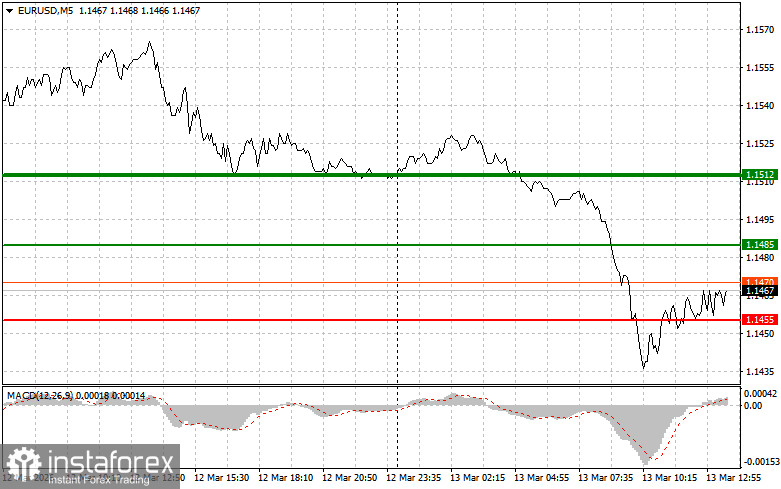
Scenario No. 1: Today, buying the euro is possible when the price reaches the 1.1485 level (green line on the chart), with a target of 1.1512. At 1.1512, I plan to exit the market and also consider selling the euro in the opposite direction, expecting a 30–35 point movement from the entry point. Growth of the euro can be expected after weak U.S. statistics.
Important: Before buying, make sure the MACD indicator is above the zero line and is just beginning to rise from it.
Scenario No. 2: I also plan to buy the euro today if there are two consecutive tests of the 1.1455 price level when the MACD indicator is in the oversold zone. This will limit the pair's downward potential and lead to an upward market reversal. Growth can then be expected toward the 1.1485 and 1.1512 levels.
Sell Signal
Scenario No. 1: I plan to sell the euro after the price reaches 1.1455 (red line on the chart). The target will be 1.1425, where I intend to exit the market and immediately buy in the opposite direction (expecting a 20–25 point move in the opposite direction). Pressure on the pair could return at any moment.
Important: Before selling, make sure the MACD indicator is below the zero line and is just beginning its downward movement.
Scenario No. 2: I also plan to sell the euro today if there are two consecutive tests of the 1.1485 price level when the MACD indicator is in the overbought zone. This will limit the pair's upward potential and lead to a downward market reversal. A decline toward 1.1455 and 1.1425 can then be expected.
What the Chart Shows
Important: Beginner traders in the Forex market should make market entry decisions very carefully. Before the release of important fundamental reports, it is best to stay out of the market to avoid sharp price fluctuations. If you decide to trade during news releases, always set stop-loss orders to minimize losses.
Without stop-loss orders, you can very quickly lose your entire deposit, especially if you do not use proper money management and trade with large volumes.
Remember that successful trading requires a clear trading plan, similar to the one outlined above. Making spontaneous trading decisions based solely on the current market situation is inherently a losing strategy for an intraday trader.


